Before the construction of the Tower of London or Cambodia’s famed Angkor Wat temple complex, the ancient city of Ocmulgee in present-day Macon, Georgia, was already a thriving capital city. The Muscogee Nation built a hub for trade, culture, and politics along the Ocmulgee River, where up to 10,000 people would visit on any given day.
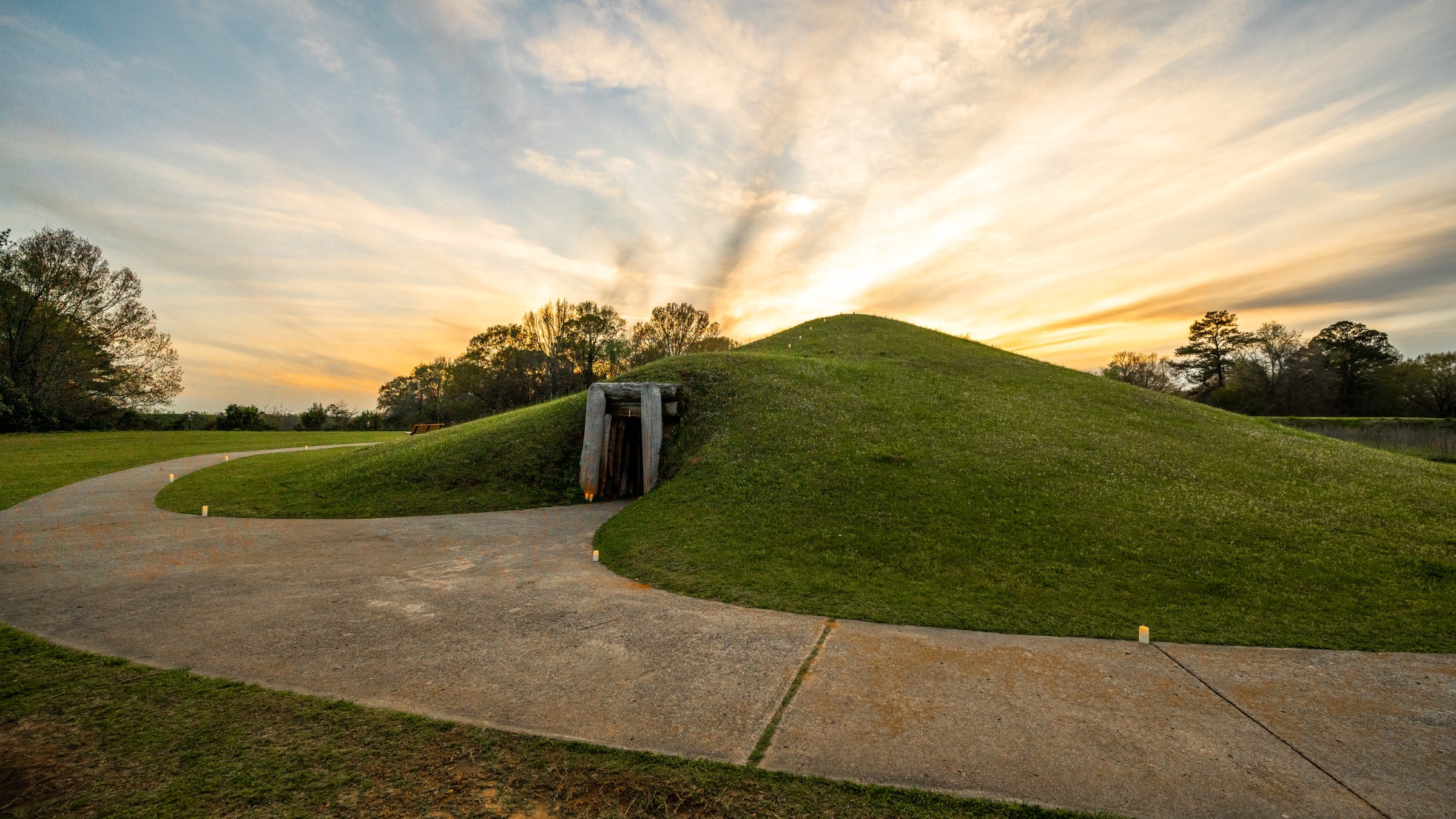
Pieces of that ancient city remain, now preserved since 2019 as the Ocmulgee Mounds National Historical Park. Thousands of artifacts from the city’s heyday are on display in the park’s visitors center. Visitors can step into the city’s reconstructed Earth Lodge, a meeting space for those who once traveled to Ocmulgee to conduct ceremonies and political meetings. Duck to go inside the Earth Lodge’s wooden frame, where, inside, visitors stand on its original, 1,000-year-old floor.
“People travel all over the world to see ancient civilizations, to see the architecture, and see that infrastructure in society. And that is what we have here in Middle Georgia,” says Tracie Revis, acting CEO for the Ocmulgee National Park and Preserve Initiative. Revis is a Muscogee Nation citizen, so Ocmulgee is part of her ancestral homeland.
The 3,000-plus-acre national historic park also includes eight earth mounds, along with eight miles of both paved and natural trails that showcase the forest and wetlands of Ocmulgee, a city with roots dating back 17,000 years. This historic park could become the nation’s next national park—the country’s 64th. It would be the first national park for the state of Georgia.
“We’re looking at 250 years of this country being founded, but we lived in these lands for thousands and thousands and thousands of years before this country was founded. As new settlers came into the region and then Georgia was the fourth state to join the union, that’s a part of the founding of this country, and we were a part of that,” Revis says.
The U.S. government forcibly removed Muscogee citizens from the area beginning in the 1820s, but the nation, now based in Oklahoma, plays an active role in preserving the area’s heritage and history. Revis has worked for years to redesignate the historic park to a national park and preserve, which could increase the number of visitors sixfold by 2031, according to a report commissioned by the National Parks Conservation Association.
The redesignation is in Congress’ hands. Bills for the establishment of the national park are pending in committees in the House and Senate. Advocates are hopeful that after the November elections, there will be movement to push the bill into law.
There are other sites around the U.S. that could become the newest crop of national parks. Arizona lawmaker Juan Ciscomani introduced legislation to elevate the volcanic rock columns of Chiricahua National Monument into a national park.
Local Sierra Club chapters explored a push to make one of the Appalachian Trail’s most recognizable stops, the Delaware Water Gap National Recreation Area, a national park and preserve, but abandoned the efforts after local Lenape tribal leaders expressed concern.
Other sites, such as Katahdin Woods and Waters National Monument in Maine, have been discussed as worthy of national park status, but at the moment, local groups aren’t currently advocating for a change.
“Our focus right now is on enhancing the visitor experience and increasing connectivity to the monument, while supporting [the National Park Service] and our gateway communities,” says Brian Hinrichs, executive director of the Friends of Katahdin Woods and Waters organization. “If an opportunity for park status arises in the future, we would be supportive.”
Avi Kwa Ame, in Nevada’s Mojave Desert, was designated a national monument in 2023 to conserve sacred land of several Native tribes, including the Fort Mojave Tribe. The agreement stipulates that the federal government consults with an advisory committee made up of mostly Tribal Nations members to manage the land.
If an Ocmulgee bill is passed, its national park status could have a major impact on the way future national parks are co-managed and preserved with input from Native communities. The proposed bills include direction that the Muscogee nation must be involved in land and animal management of the Macon site. It also includes directives to hire Muscogee citizens to lead on-site storytelling of the land, culture, and heritage of Ocmulgee.
“We are trying to set the standard with our bill to keep making bigger inroads for tribes to be able to be partners with the National Park Service,” Revis says.

Visitors don’t have to wait on Congress to enjoy a visit to this distinctive land. Every September, the Ocmulgee Indigenous Celebration at the national historic park is a homecoming for the Muscogee nation. For everyone else, it’s an opportunity to learn about Muscogee heritage and culture. And any time of year, visitors can hike near the park’s mounds or to the Ocmulgee River, where deer or the occasional alligator gather for a drink. Most park trails are short—about a mile one way—but they connect to the Ocmulgee Heritage Trail, a 13-mile trail extending outside of the park’s boundaries.
For those who come to learn about the storied legacy of Ocmulgee, a visit entails a climb up the wooden staircase to the top of the Great Temple Mound. This nine-story-tall mound is the largest in the park and was once home to the ancient city’s leader. Today, it overlooks two distinct cities: downtown Macon, a growing cultural hub known for its cherry blossoms and music history; and the original Ocmulgee, the capital city that predated Macon by thousands of years.
“It is important to conserve these lands, to protect these lands, to tell the stories of these lands,” Revis says. “To make sure they are protected for the next 250 years.”
Related Reads